
Tea in M’Hamid is a useful starting point for understanding hospitality as something people do together, not simply a drink placed before a guest. A local heritage publication connects its preparation with welcome, but also with breaks during the day and meals. That everyday setting matters as much as the more photographed gesture of a raised teapot.
After our field note on life in the M’Hamid oasis, this article turns from gardens and work to the objects and time around a tea tray. It follows a published local account, a Moroccan material-culture study and dated photographs. It does not turn those sources into a single script for every home.
At a glance
- A 2021 heritage book places tea within hospitality and everyday life in the M’Hamid oasis.
- The tray, pot and glasses are part of the encounter, not just decorative background.
- A historical photograph documents a raised pour at a named M’Hamid hospitality venue in 2010.
- Ingredients, serving sequences and responsibilities should not be treated as identical in every household.
An invitation to sit
The tea section of Ouled Youssef: An Old Ksar in the M’Hamid Oasis, published in 2021, associates brewing and pouring with hospitality, respect and friendship. It also places tea alongside daily pauses and meals. The account appears on printed pages 83–84, within a wider record of the ksar and oasis.
That combination offers a better introduction than describing tea only as a ceremony staged for a visitor. Welcome can belong to ordinary life. In reading the account, it is worth keeping both scales in view: the preparation of a drink and the relationship between the people sharing it.
The book grew from a heritage project, rather than a new survey of every M’Hamid household. Our Ouled Youssef entry explains more of that setting. Here, its tea section is a local point of departure, not authority for an inflexible etiquette.
Around the tray
A tray brings separate objects into one arrangement: pot, glasses and the space in which they are served. The local book describes Chinese gunpowder green tea, fresh mint and sugar, prepared in a metal teapot. Its tea-set illustration identifies a tray on legs, a pot and glasses. These are the publication’s details, not an inventory we have made inside a home.
The tray also has its own history. In Baptiste Buob’s 2006 study of the Moroccan tea tray, making, presentation and use belong together. His opening account on page 103 describes varied preparations and settings, including homes, cafés and workplaces. The object carries social and material meanings beyond holding a pot safely.
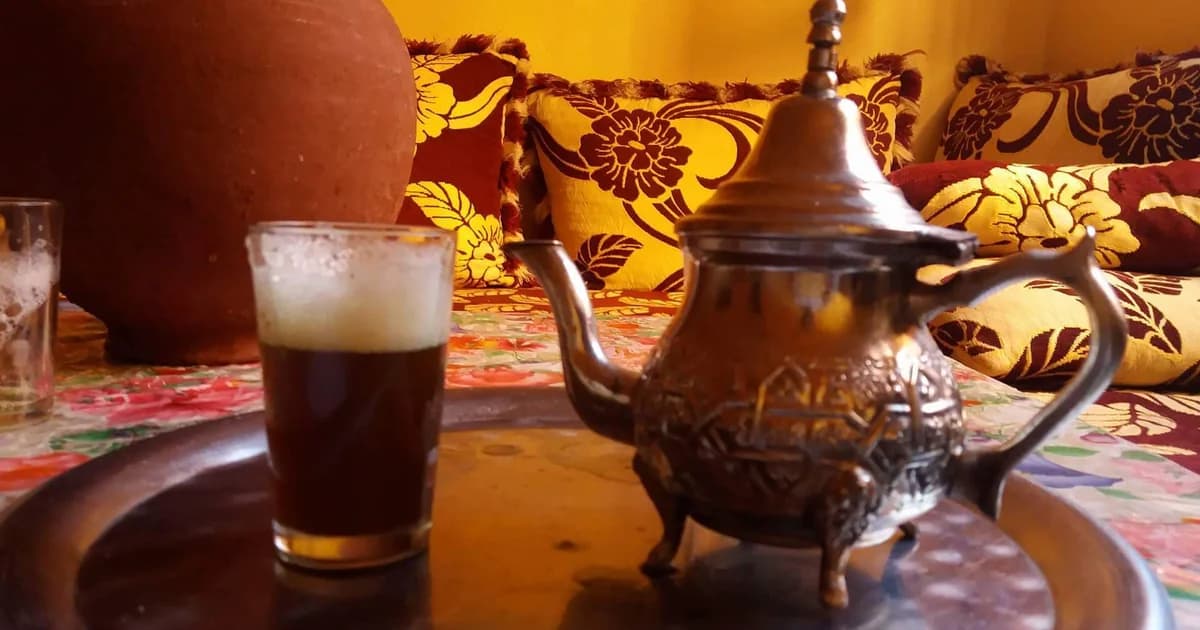
Look again at the cover photograph with that in mind. The glass, patterned metal and background textiles are visible; the relationships around them are not. Nor does the source locate that image in M’Hamid. A beautiful arrangement is an invitation to notice objects closely, not evidence that an entire community uses the same set.
Preparing and pouring
On printed pages 83–84, the local heritage account describes briefly boiling the tea and a pour that begins near the glass, rises away from it and returns. The authors connect this movement with aeration and foam. That is their description of the preparation, not a test establishing the taste of every cup.
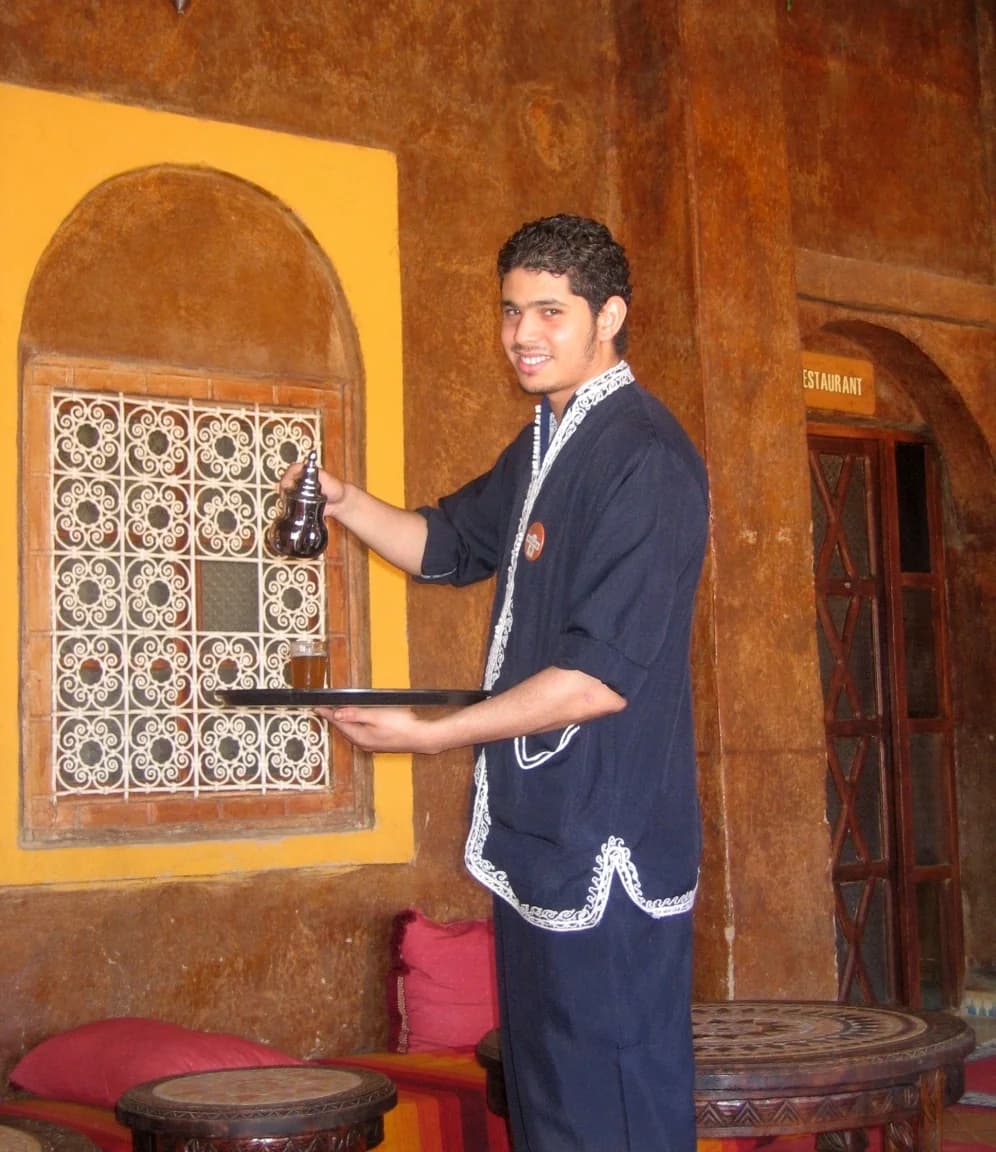

The photograph gives that movement a concrete, dated setting. A person is pouring into a glass on a tray; the source names the venue and village. It cannot tell us what was said, how the tea tasted or how often the same person prepared it. Those are different kinds of evidence.
This is therefore not a recipe with measured quantities and a promised result. A tested recipe would need someone willing to explain their own method, including ingredients, sequence and choices. It would be their preparation, credited as such, rather than “the” recipe of M’Hamid.
Time spent together
The local book’s daily pauses and meals sit alongside its account of welcome. Tea belongs to more than the arrival of a guest. Read together with Buob’s homes, cafés and workplaces on page 103, these settings shift attention from a special performance to the occasions that make room for it.
A break in work, a meal and a welcome are different occasions. Asking which one an account describes helps keep the people and their purpose in view, rather than making the teapot the entire story. This is an interpretation of the published settings, not an observed gathering.
For NomadeTrip, “shared time” means looking at that company and occasion alongside preparation. It does not mean that every cup produces intimacy or that life in the oasis is unhurried. A future local contribution could give one such moment its own words, with permission.
Traditions without fixed rules
Wider accounts can help a reader recognise a custom, but they can also flatten differences. The Alimentarium museum’s Tea in Northwest Africa discusses mint tea, serving gestures and hospitality across a broad region. It also describes a sequence of three glasses. That regional interpretation is not proof of a rule followed at every M’Hamid table.
For the same reason, this article does not assign preparation to one gender, insist on a particular number of servings or declare a refusal universally offensive. Such instructions would require more specific evidence than a regional overview and a heritage chapter.
A tradition can be recognisable without being identical everywhere. Keeping the setting attached to an account makes it more useful: a particular person’s method, a photograph at a named venue, or an author’s description from a stated period. The differences are part of the subject, not obstacles to a tidy story.
Continuing with local voices
The next layer should come from a willing local contributor, not another general description. A conversation could begin with one tea set, one preparation or one remembered gathering.
Questions worth asking include:
- What names do you use for the objects and stages of preparation?
- How did you learn your method, and what do you change according to the occasion?
- What makes sharing tea meaningful to you, beyond the drink itself?
- Which details, names or photographs would you prefer not to publish?
- How would you like your contribution credited and reviewed?
These are proposed questions; no interview has yet taken place. A contributor should be able to check their account, correct it and choose whether to be named. Such a contribution would enrich the living-culture collection without asking one person to represent everyone.
Editorial note
This research edition belongs to the NomadeTrip editorial project. Its relationship with a sister travel business is disclosed separately. No booking or venue recommendation is made here. AI assisted research and writing; a named human editor, local review and a correction/contact pathway still need confirmation.
Sources were checked on 22 October 2026. The 2021 Ouled Youssef book supplies the local heritage account; Buob’s 2006 paper concerns Moroccan tea trays more broadly; the Alimentarium page offers a regional museum interpretation. None is presented as a current survey of every household in M’Hamid.
The photographs date from 2018 and 2010. Their creators, source descriptions, licences and changes are given in the captions. No image has been taken from the copyright-protected heritage book. The canonical address is a proposed publication location; this local research edition is not yet published.