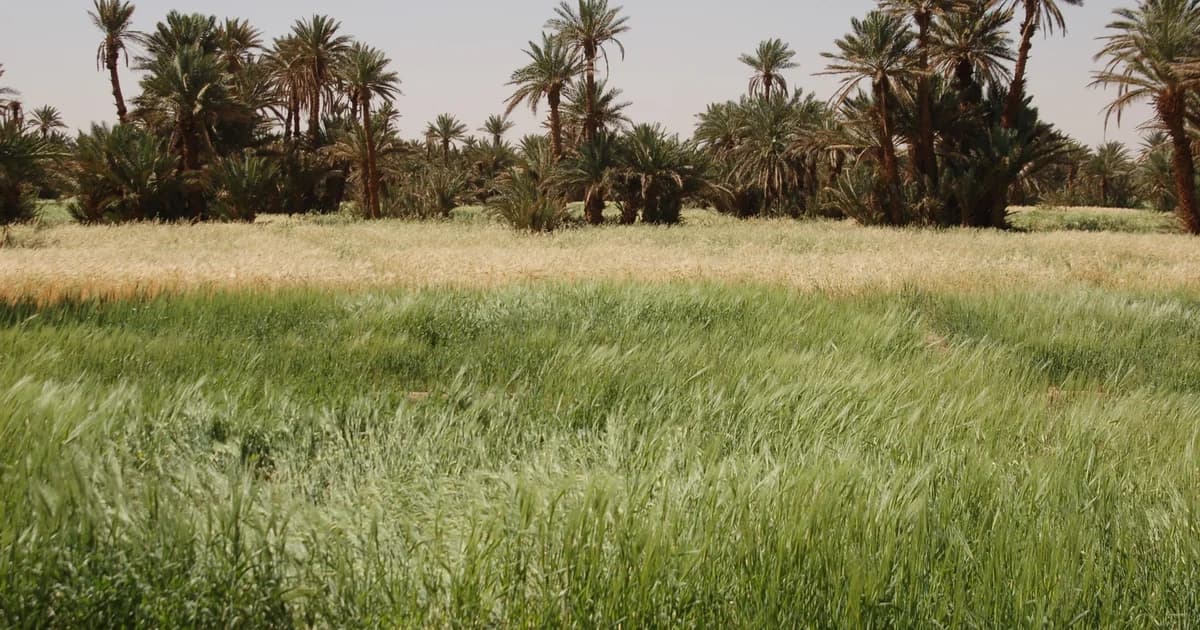

Ouled Youssef is a named ksar in the M’Hamid oasis, documented in the 2021 ArCHIAM and Terrachidia heritage publication. It offers a closer scale than the sweep of the dunes: a settlement, its entrances and the knowledge involved in building and caring for it.
Our M’Hamid introduction sets out the wider landscape. Here, the focus is the settlement’s entrances, earthen building methods and documented conservation, leaving room for residents’ accounts rather than speaking on their behalf.
At a glance
- This entry concerns Ouled Youssef in the M’Hamid oasis, not other places with the same name.
- A ksar is a fortified settlement; the plural is ksour.
- The 2021 book describes two entrance gates connected by a north-south main street, with a privacy-preserving turn at the south gate.
- A published account of the 2019 Sidi Abdullah Khalifa shrine restoration documents community agreements, master builders and local apprentices.
A ksar within the M’Hamid oasis
Ouled Youssef belongs within a landscape of settlements, not a desert imagined as empty space. Giamila Quattrone’s account in the July 2023 ICOMOS CIAV newsletter identifies it among the M’Hamid oasis’s traditional fortified villages. The term ksar names a settlement rather than an individual house or a dune camp.
This is a useful shift in scale from the Draa Valley field note. The valley article follows relationships between water, cultivation and settlement. Ouled Youssef gives those broad questions a named architectural subject: entrances, routes and homes, rather than a generic image of an earthen village.
Gates, houses and shared space
The 2021 book records a north-south street linking two entrance gates, with courtyard houses grouped closely together. Its south-gate survey identifies mud-brick construction and an elbow-shaped passage that screens views of the main street. The north gate opens from the gardens and marabout toward a covered passage and communal open space. These descriptions come from the published survey and gate accounts, printed pages 47-54.
Read the features together. The turn at the south entrance creates privacy; the northern passage connects the outside approach with shared space. Houses make the domestic scale as important to the account as the outer entrances. These are relationships within a settlement, not details of a freestanding monument.
The survey is a dated record, not a current access notice. This entry does not assign a founding date or repeat an origin story without further verification.
Earth is a material, not a single technique
Earthen construction includes different ways of making a building. Quattrone’s 2023 account of M’Hamid building techniques, printed pages 23-24 distinguishes rammed earth from mud bricks. In rammed-earth work, builders compact damp soil in temporary formwork. Mud bricks are made in moulds and dried before use. The account also discusses renders, or surface finishing coats.
The distinction is useful even before a reader learns local technical vocabulary. A material tells us what something is made from; a technique tells us how it was formed. A wall, a brick and a finishing coat should not be treated as interchangeable simply because they share an earthy colour.
These are descriptions of the oasis’s building practices. They do not let us identify the structure of an unseen Ouled Youssef house or prescribe a repair. The developing glossary offers a place to connect terms, but local names and usage still require review.
The 2019 restoration of Sidi Abdullah Khalifa
The restoration of the Sidi Abdullah Khalifa marabout provides a documented example of conservation associated with Ouled Youssef. In their 2021 journal paper, Marta Colmenares Fernández, Alejandro García Hermida and Carmen Moreno Adán describe the work carried out in 2019. They locate the shrine between Ouled Youssef and M’Hamid El Ghezlane, in the western part of the oasis.
Their account places agreements with local community leaders and institutions before the building work. It describes technical documentation, the involvement of master builders and young local apprentices, and work using traditional materials and forms alongside international participants. This is the practitioners’ account of their intervention, not an independent assessment of its long-term results.
The sequence makes craftsmanship visible. Conservation is not just the appearance of a completed façade; it also involves decisions about what to retain, who knows how to work with it and how that knowledge is shared. The paper presents the marabout as a locally venerated shrine, so it should not be reduced to a visitor attraction or assumed to offer public access.
Living heritage includes learning
Building knowledge is also the focus of a later research announcement. On 5 January 2026, the University of Liverpool announced an ArCHIAM project intended to combine practical training with digitally assisted learning. It named Ksar Ouled Youssef as the setting for using Heres, a multimedia construction manual, during a Terrachidia-led Oasis Campus.
The announcement describes intended activity. It is not evidence here that every planned session took place or that a particular outcome was achieved. Its relevance is the question it puts forward: how can documentation support the transfer of practical knowledge rather than merely preserve an image of a building?
That question connects this place entry with the living-culture collection. Those topics remain developing previews. They should grow through attributed contributions from people who make, teach and use the practices being described, not through a single account standing in for a whole community.
Continuing the record with care
The 2026 university announcement also proposes documenting everyday routines, including farming, domestic activities and crafts. This intended scope invites a wider reading of heritage than a collection of repaired buildings, without supplying residents’ testimony here.
For a future local contribution, useful questions are concrete: what do residents call a particular space? Which repairs or changes matter to them? Who should be credited for a craft or account? Answers require consent, attribution and context. None has been invented for this entry.
Return to the places collection with a named settlement in mind. Ouled Youssef gives the archive a subject that can be revisited and corrected: not a generic earthen village, but a place whose published record can be put into conversation with local knowledge.
Editorial note
This is a research draft for the NomadeTrip editorial project. The site’s relationship with its sister travel business is disclosed separately; this article contains no booking recommendation. AI assisted research and writing. A named human editor, local review and a correction/contact pathway still need confirmation. No firsthand observations, interviews, current access information or original architectural survey are claimed.
Research was checked on 22 October 2026. The book, restoration paper, newsletter account and university announcement involve overlapping ArCHIAM and Terrachidia contributors. They are not independent corroboration of every claim. Their dates and purposes remain visible in the text.
The book’s photographs and drawings have not been reproduced: public access does not establish permission to reuse them. The licensed cover image is labelled as wider-oasis context. The canonical address is a proposed publication location; this local draft is not yet published.